A Big Day

Resting with football bink.

One week after going into surgery Wes continues to make great progress. Today his breathing tube was removed which created an angry Wes with a tiny, gravely cry. He calmed down after his beloved football bink was finally returned to him and Emily sang him some songs. Now he’s resting comfortably. The nurse, Shauna, also removed an IV from his right arm, the arterial line in his left arm is next. The chest tubes are still in, but should be coming out tomorrow and that should further increase his comfort. He’s thinner since he’s only had liquid nutrition and they’re pushing out as much fluid as they can. Soon, though, he’ll be able to start trying to eat.

So far, as different tubes and wires have been removed or medications changed he has done a great job of tolerating each new situation, which is a great sign.

Because the breathing tube is out, our role as active comfort for him will increase, so tonight is the first night one of us will stay in the hospital room. There is a cushioned bench near the window that turns into a bed with the addition of bedding and a pillow and a curtain for privacy. He will remain in the cardiac ICU until he is off the external pacemaker.

Everything is better when you have your 'comfort' hammer.
Everything is better when you have your ‘comfort’ hammer.

Dr. Jim Saperstone, Wes’s pediatrician, stopped by for a quick visit. He was in Boston visiting family and wanted to see how things were going. It was nice to see him, if only for a few minutes. He was very impressed with Wes’s recovery. In a way that only Dr. Jim can, he summed up this whole experience with the simple statement, “Isn’t this place f**king amazing!?” and it truly is.

After a nice rest Wes woke up around 3:30 but was not nearly as agitated. After he looked around for a while he turned to Emily and gave her a beautiful smile. It was so nice to see that smile. It was what we’ve been waiting a week for and we didn’t even know it.

A Big Day

Wes’s Heart

Wes was born with three major heart defects that in their own way worked together to keep him going for 13 months before it was finally time for surgery. If any one of the three defects were not present at birth he would have needed surgery immediately before the final repair could be made later.

A normal heart on the left. Wes's heart (pre-surgery) on the right.
A normal heart on the left. Wes’s heart (pre-surgery) on the right.

Wes had a large hole (VSD) between his ventricles (black circle on the picture). He also had a narrowing of the pulmonary artery at the valve and the main defect was that his ventricles were reversed. This meant the ‘stronger’ ventricle that normally pumps to the body was pumping to the lungs and the ventricle that normally pumps to the lungs was pumping to the body. If this was left as-is the ventricle pumping to the body would eventually wear out because it was not designed to work that hard. His lungs never received too much blood because of the narrowed pulmonary artery valve and his body received adequate blood flow because the VSD allowed the pressure from both ventricles to send blood out.

Surgery became necessary when his blood oxygen level dropped into the mid-eighties (normal is 100%) due to his growth and continued pulmonary obstruction in combination with the VSD.

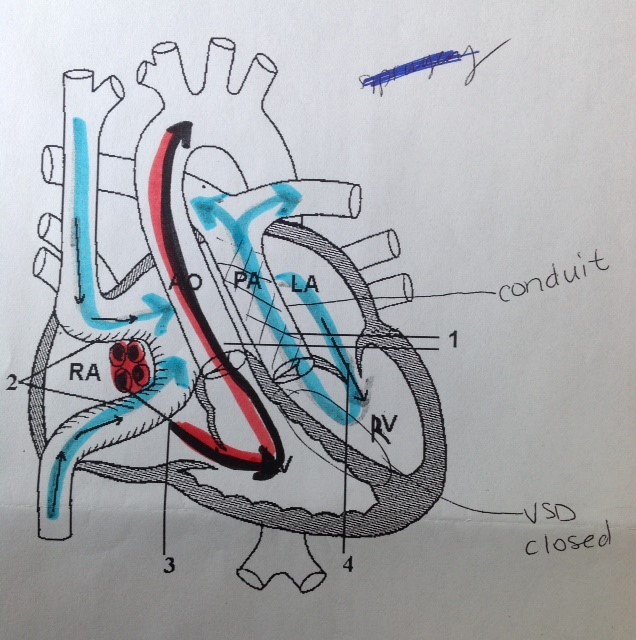
Wes's heart after surgery.
Wes’s heart after surgery.

Dr. Emani performed what is a called a double switch using a Nikaidoh procedure. They closed the VSD, relatively minor compared to everything else that had to be done. They then removed the section of narrowed pulmonary artery with its bad valve and installed a new section and valve from a donor and connected it to the correct ventricle. He then moved the aorta and connected it to the spot where the pulmonary artery used to be so the ventricles could now pump to where they were supposed to. He then had to create a series of baffles and conduits to get the blood to through the atria to the correct ventricles (hence the ‘double’ switch). It was a massive reworking of the entire heart but it now functions as it should and is performing beautifully. At some point the donor conduit/valve will have to be up-sized as the heart grows but that procedure can be done through a catheter and is not considered major surgery.

The main electrical system of Wes’s heart was very close to where the aorta was detached for relocation so Dr. Emani warned us that the conductivity may be interrupted. If the conductivity did not return they would have to install a pacemaker, but so far that does not seem to be necessary.

As you can see from my brief overview of the procedure, it was very a complex situation but ultimately a complete success. Thank you all for your continued support and well wishes.

Wes’s Heart